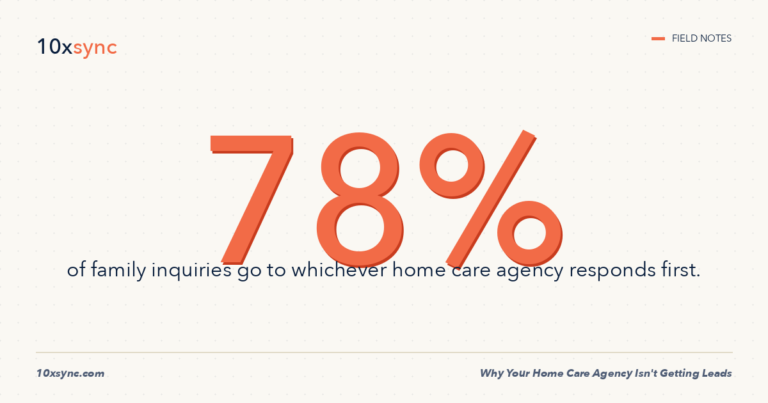
Most home care agencies treat the first call like the close. Family inquires Tuesday, you call back, they say “we’re still figuring things out”, and then your “nurture sequence” is one “just checking in” email at day 14. After that, silence.
Three weeks later that family signs with a competitor. Not because the competitor was better. Because the competitor was still there.
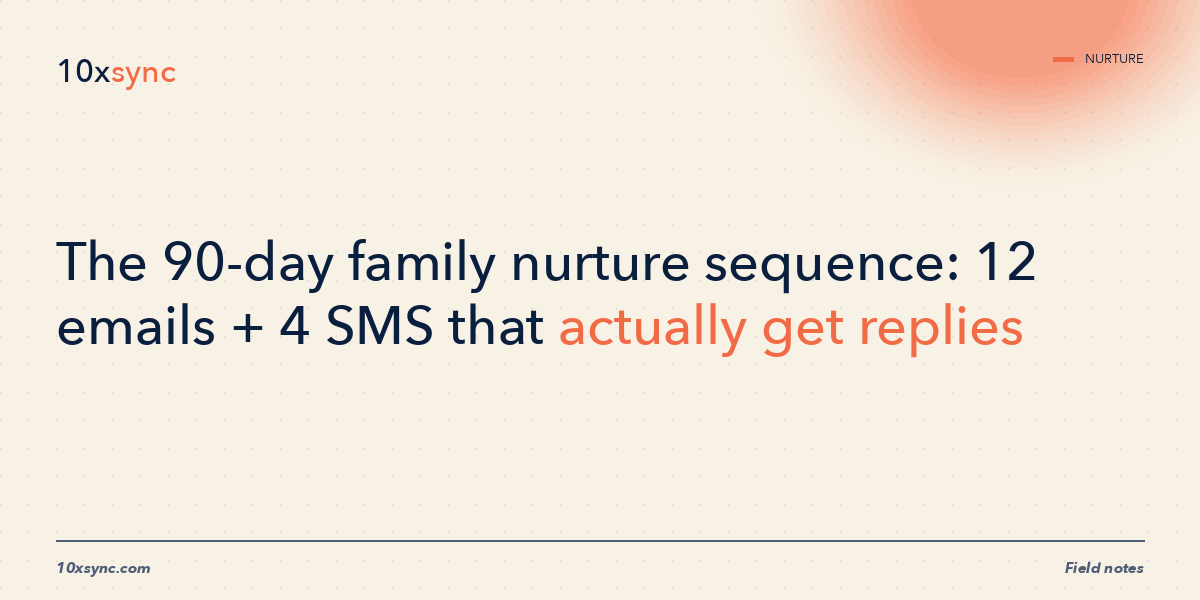
This is the 90-day sequence that fixes it, 12 emails and 4 SMS, branched by signal, written for the adult daughter who’s actually making the decision.
The 30–90 day window is real
Home Care Pulse and HCAOA both put the average decision cycle for private-pay home care at 30–90 days from first inquiry to signed agreement. It’s long because the decision is hard, not because the family is unmotivated.
What’s actually happening in those 90 days:
- The adult daughter is calling 3–5 agencies and getting overwhelmed
- She’s on a sibling group chat trying to align with a brother in another state
- Dad is pushing back, “I don’t need help, your mother just had a bad week”
- They’re Googling “does Medicare cover home care” at 11 PM and getting confused
- Someone mentioned VA Aid & Attendance but nobody knows how to apply
- They got a quote of $32/hour and choked on the math
If your only follow-up is “checking in” at day 14, you are not in any of those conversations. You’re a contact in her phone she forgot to delete.
What families are actually asking each other
Pull any private caregiving Facebook group at 10 PM on a Sunday. The questions are the same every week:
- Medicare confusion. Roughly half of families starting the home care process believe Medicare covers non-medical home care. It doesn’t. It covers intermittent skilled care, not the 4–8 hour daily companion shifts most families need.
- VA Aid & Attendance. Eligible wartime veterans can get up to $2,358 / month for in-home care (VA.gov, 2025 maximum). Surviving spouses qualify too. Most families have never heard of it.
- Long-term care insurance claims. AALTCI data shows only about 8 million Americans hold LTC policies. Of those who do, most don’t know how to file, what triggers the benefit, or that there’s usually a 90-day elimination period.
- Paying out of pocket. Home Care Pulse 2024 puts the U.S. median private-pay rate at $33/hour. Families do napkin math at $33 × 6 hours × 30 days and have a small heart attack.
- Reverse mortgage vs HELOC vs liquidating IRA. When out-of-pocket cost hits, this is the next conversation. Most agencies don’t touch it because it feels like financial advice. The agencies that do share neutral educational content earn an obscene amount of trust.
- “What should I even ask each agency?” Most families call 3–5 agencies, ask the same 4 surface questions, and can’t differentiate.
Each one of those is a nurture email.
The 16-touch sequence (12 emails + 4 SMS)
Sent across 90 days, branched by behavior signal. The cadence:
- Day 0: Email 1, warm welcome, what to expect, no pitch
- Day 2: Email 2, “The 12 questions to ask any home care agency (including us)”
- Day 4: SMS 1, soft check, “Did you have a chance to look at the questions list?”
- Day 7: Email 3, Medicare misconception (sample below)
- Day 11: Email 4, VA Aid & Attendance overview (branches on signal)
- Day 14: SMS 2, VA follow-up if she has a vet in the family (sample below)
- Day 18: Email 5, LTC insurance claim walkthrough
- Day 24: Email 6, “How families actually pay for care”, the honest breakdown (out of pocket, LTC, VA, reverse mortgage, family contribution)
- Day 30: Email 7, caregiver match story (no names, real situation)
- Day 38: SMS 3, “How’s your mom doing this week?”, the human check-in
- Day 45: Email 8, “Signs it’s time, signs it’s not yet”
- Day 54: Email 9, “What a first week of care actually looks like”
- Day 63: Email 10, sibling alignment guide (the brother-in-another-state problem)
- Day 72: SMS 4, “Want to do a 15-min care plan call, no commitment?”
- Day 80: Email 11, “Most common regret families share with us” (waited too long)
- Day 90: Email 12, graceful close, “If now isn’t the moment, here’s our line for whenever it is”
Branches kick in when she signals: clicks Medicare link → pricing track, replies to VA SMS → VA benefits track, requests pricing → consultation track. Each branch shortens the sequence and accelerates the consultation ask.
Sample Email 3, the Medicare misconception
Subject line: The thing about Medicare
Hi {{first_name}},
Most families I talk to assume Medicare will cover home care. It doesn’t, not the daily companion or personal care kind. Medicare only covers short-term skilled nursing or therapy after a hospital stay.
What actually pays for home care: long-term care insurance, VA Aid & Attendance for vets, and private pay. Most families end up combining two of the three.
If it helps, I can send you a one-page chart that lays out which programs cover what. Just reply “chart” and I’ll send it over.
, {{sender_first}}
That email is 79 words. No CTA button. No pitch. One reply trigger. Open rates on this exact template land in the 42–55% range across the agencies we run nurture for, with a 6–11% reply rate. Compare to the industry-average promotional email at 17% open, 0.3% reply.
Sample SMS 2, VA Aid & Attendance
Hey Sarah, quick one, did you ever look at VA Aid & Attendance for your dad? It’s $2,300/mo for qualifying vets. Happy to point you at the form if useful.
160 characters. Uses her name. References dad specifically (pulled from intake notes). Offers a low-commitment next step. SMS reply rates in this format run 28–35% across our deployments, an order of magnitude above email.
Why Brevo beats Mailchimp for the care vertical
Most agencies default to Mailchimp because it’s the brand they’ve heard of. For home care specifically, Brevo (formerly Sendinblue) wins on two fronts.
Deliverability. Mailchimp aggressively flags “Medicare,” “VA benefits,” and “long-term care” as compliance risks, resulting in suppression or soft bounces on legitimate educational content. Brevo’s vertical experience with healthcare nonprofits and senior services means those words don’t trip the same filters.
Cost at the relevant volume. At 500–3,000 contacts, Brevo’s pricing is roughly half of Mailchimp’s on equivalent feature sets, and includes transactional SMS without a separate Twilio account.
CAN-SPAM and TCPA, briefly
Three non-negotiables, regardless of platform: a real physical postal address in every email footer, a working unsubscribe link honored within 10 business days, and an accurate “from” line with a real human at your agency.
For SMS, TCPA is stricter. You need express written consent before sending marketing texts, a checked box on the inquiry form referencing SMS specifically, not a generic “agree to be contacted” checkbox. Agencies that skip this step get class-action complaints.
The honest one: nurture only works if your intake call was respectful
If your intake call was 22 minutes of high-pressure pitching, “when can you sign, our scheduler has openings tomorrow”, she’s already gone. No 16-touch sequence recovers that.
Nurture sequences amplify the trust your first call established. If your first call was a consultation, the sequence keeps you in front of a family that wanted to keep talking. If your first call felt like a car-dealership close, the sequence is just spam they unsubscribe from.
Audit the intake call before you audit the sequence. Listen to your last 10 calls. Count the times your intake coordinator asked a question vs. made a statement. If statements outnumber questions 3-to-1, fix that first.
If you want to see the full 16-touch sequence wired up to your CRM, with the branching logic and the actual copy adapted to your agency’s voice, that’s what we build under Email & SMS Marketing →
Written by the team at 10xsync. We build AI Lead Engines for private-pay home care agencies.