You’re spending more on Google Ads than ever, and your inquiry count is dropping. You added Angi. You upgraded the website. The close rate sits at 18% when the industry average is 25%. Sound familiar?
You don’t have a lead-generation problem. You have a lead-conversion problem, and the fix doesn’t involve buying more leads.
This is what’s actually happening to most private-pay home care agencies in 2026, and the six places they leak the leads they’re already paying for.
The economics broke in 2024
Customer acquisition cost in home care hit $800 in 2024, up $208 year-over-year, the highest jump in five years (Activated Insights 2024 Benchmarking). Average client lifetime value is roughly $12,500. The LTV:CAC ratio is still healthy in absolute terms, but the trend is collapsing.
The instinct most owners have when CAC rises is to buy more leads. Run more ads. Sign up for another paid network. The problem: the inquiries you’re already getting aren’t closing. Industry-average inquiry-to-client conversion is 15–25%. Top-performing agencies hit 30–40% on the same lead volume. The gap isn’t about traffic. It’s about what happens after the click.
The 5-minute rule that nobody runs
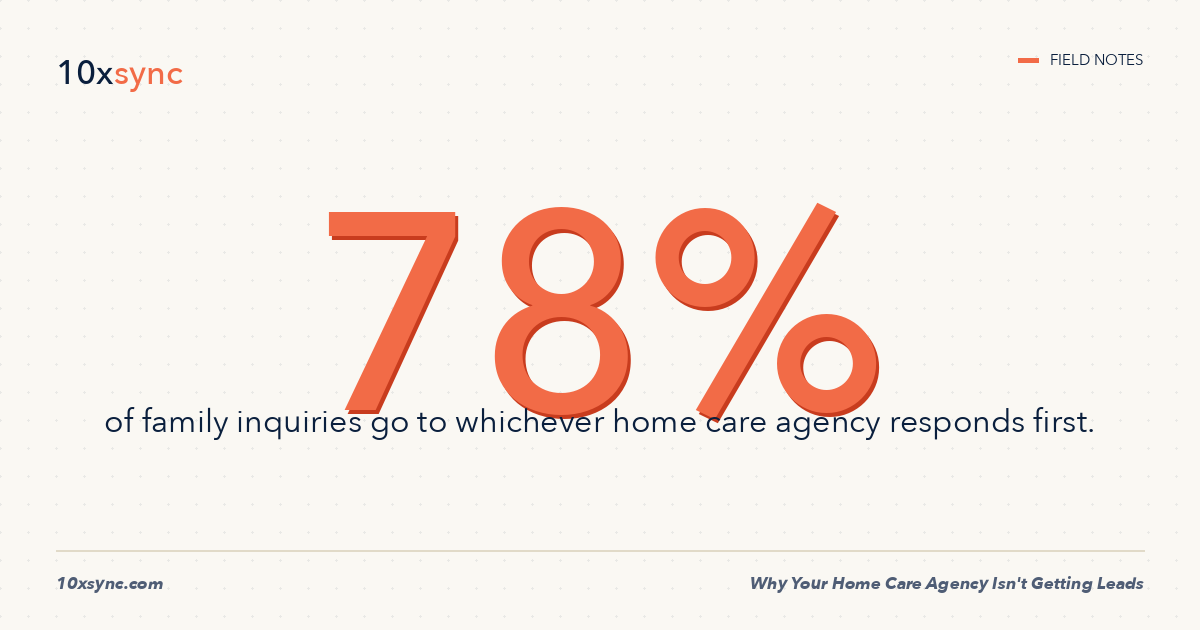
Classic HBR research, still cited everywhere: leads contacted within 5 minutes are 100× more likely to qualify than leads contacted at 30 minutes. After 30 minutes, lead quality drops 80%. And 78% of buyers go with the first company that responds.
For home care specifically, the math is brutal. 62% of business calls go unanswered during normal hours across all SMBs (Aira). Senior care specifically misses about 20% of inbound calls; senior living misses 37%. Of the calls sent to voicemail, 80% don’t leave a message, and 85% never call back.
One missed family call at $12,500 LTV and a 50% close rate is a $6,250 expected-value loss. Most agencies miss 3 a month. Do the math on a year.
The Angi/Care.com trap
When CAC rises, the next instinct is to buy pay-per-lead. Angi sells home care leads for $15–$85 each. Care.com Pro is $39/mo plus per-lead fees. These platforms promise efficient cost-per-lead.
The numbers don’t survive scrutiny. Angi leads are sold to 3–8 contractors simultaneously. If you don’t respond within 60 seconds, the closing-rate is in the low single digits. The real cost-per-booked-client lands around $1,430 (Hook Agency analysis of Angi reviews).
You can rent leads, or you can build your own lead engine where every inquiry is exclusively yours. The unit economics aren’t even close.
The six places agencies actually leak leads
Leakage maps to fixable failures. In order of frequency:
1. The phone goes unanswered after 5 PM. 55%+ of home services call volume is after-hours / weekends. A live answering service at $200–$300/mo takes messages but doesn’t book assessments. An AI receptionist books appointments, captures situation + location + care level, and texts you the transcript before breakfast. Cost: $497/mo standalone. Math closes itself in 1–2 saved calls a month.
2. The phone rings while you’re on another call. The second-most-common loss point. Missed-call text-back fires within 30 seconds of any unanswered call with a personalized SMS. About 65% reply within 10 minutes.
3. The inquiry form is too long. Healthcare website forms with more than 5 fields convert about half as well as 3-field forms. Take everything off your form except name, phone, situation. Ask the rest on the call.
4. The follow-up stops after one touch. Families take 30–90 days to decide. You called once on Tuesday. They’re still researching three weeks later. By then they’ve chosen someone else. A 90-day nurture sequence with educational content (Medicare benefits, VA Aid & Attendance, what to ask any agency) keeps you in front of them when they’re ready.
5. Your Google Business Profile has 12 reviews. The local pack threshold is 15–20 reviews to compete, 50+ to crack the top 3. An agency at 150 reviews / 4.8 stars almost always outranks one at 12 reviews / 5.0 stars.
6. The discharge planner stopped calling. Hospital discharge planner referrals are roughly 9% of all home health referrals industry-wide, but they’re the highest-LTV leads you can get because they’re pre-qualified by clinical urgency. Most agencies make a relationship visit once and never follow up. Quarterly check-ins, even by email, keep you in the rotation.
How to audit your funnel in 15 minutes
Pull these five numbers from the last 90 days. Most agency owners can have them in 15 minutes from QuickBooks + their CRM + Google Analytics:
- Inbound inquiry count (calls + form fills + chats)
- Booked-assessment count
- Signed-client count
- Total marketing spend (ads + agency + tools)
- Average monthly client value (their billable amount)
Now run these ratios:
- Inquiry → Assessment booking rate. Top performers: 60%+. If you’re below 40%, the leak is response time + after-hours capture.
- Assessment → Signed client rate. Top performers: 60–70%. If you’re below, the leak is your in-person pitch or follow-up.
- Customer acquisition cost. Marketing spend ÷ signed clients. If above $1,000, you’re overpaying for traffic OR underconverting it.
Where the number is worst is where to invest first. Spending more on ads while your inquiry-to-assessment rate is 28% is throwing money into a sieve.
What actually fixes it
In order of leverage:
- Plug the after-hours leak (AI receptionist + missed-call text-back). Captures the calls you’re currently losing.
- Tighten the inquiry form to 3 fields. Doubles the conversion rate without any other change.
- Set up a 90-day family nurture sequence. Recovers the 60% of inquiries that don’t close on day one.
- Get to 50 Google reviews. Compounds with everything else by making the next inquiry cheaper to acquire.
- Re-establish discharge planner relationships. Highest-LTV referrals you can get.
- Only then: increase ad spend.
Agencies that work down this list see CAC drop 20–40% within 90 days without spending another dollar on traffic.
What to do with this
If you want to see exactly which of these six leaks your agency has, on a live screen share, in 15 minutes, book the audit. We pull up your website, your Google Business Profile, your competitor’s rankings, and your call-pattern data, and we tell you where you’re bleeding.
No pitch deck. No follow-up nag emails. If we’re not the right fit, we’ll say so.
See the full AI Lead Engine approach →
Written by the team at 10xsync. We build AI Lead Engines for private-pay home care agencies.