Industry-average caregiver turnover hit 75% in 2024, the lowest in five years. The peak was 81.6% in 2018 (Activated Insights 2025 Benchmarking). Replacement cost per caregiver: $2,600 minimum, up to $5,000 in some markets. For a 100-caregiver agency, that’s $171,600 a year just in re-hiring.
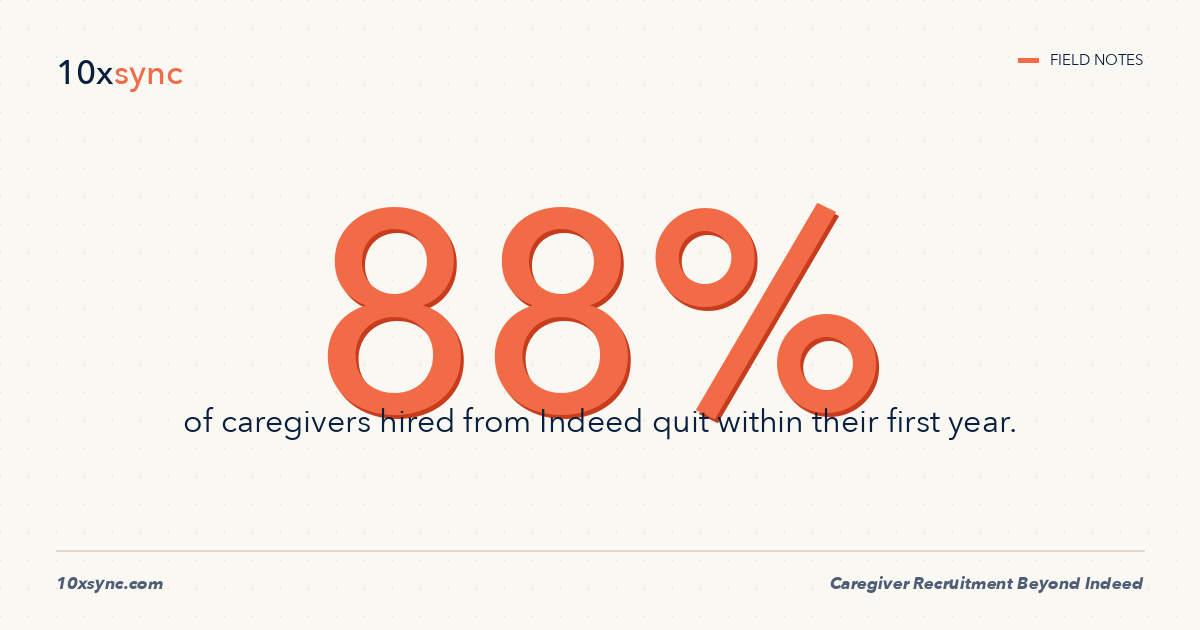
Most agency owners know these numbers. Almost none of them know the more painful one: Indeed, where 39–66% of caregiver applications come from, has an 88% turnover rate on the caregivers it produces. The cheapest applicant source by cost-per-lead is the most expensive source by cost-per-retained-employee.
This is the Indeed paradox, and what to do instead.
The math nobody runs on caregiver acquisition
If you’re running a typical $1M–$3M home care agency with 60–120 caregivers, here’s what your hiring funnel actually costs:
- Indeed sponsored job posts: typically $200–$500/mo per location for sponsorship + $10–$25 per apply
- Applicant volume: Indeed delivers 39–66% of total applicants (Activated Insights)
- Quality: the applicant-to-hire ratio for home care is 12.8% (Activated Insights), meaning you need to screen ~8 applicants for every 1 hire
- Retention: 88% of Indeed hires turn over within a year
The full-loaded cost of an Indeed-sourced caregiver who quits in 4 months: sponsorship + per-apply fees + background check + orientation + lost productivity during ramp = roughly $1,800–$3,500 down the drain per caregiver. Multiply by 75% of your headcount per year. You’re leaking real money.
Where good caregivers actually come from
Activated Insights tracked caregiver retention by source. The data is unambiguous:
- Word-of-mouth: 9.4% of applications, $520 acquisition cost, 59% turnover (lowest)
- Employee referrals: 14.6% of applications, similar low turnover
- Career page (your own website): 17% of applications, but 31% of actual hires (highest applicant-to-hire ratio)
- Indeed/job boards: 39–66% of applications, $475 acquisition cost, 88% turnover
The pattern: the channels that produce the highest volume produce the lowest quality. The channels that produce the highest quality need active investment to build.
Five channels that beat Indeed
1. Your career page on your own website. Career-page applicants are 17% of total volume but 31% of actual hires (Activated Insights). They’re self-selected, they researched your agency, decided they liked you, and applied. Most home care agency career pages are an after-thought. They should be your highest-converting acquisition channel.
An AI caregiver-screening chatbot on that page captures applicants 24/7, verifies CNA/HHA cert, asks the 8 questions that disqualify 70% of bad fits, and books interviews directly. Most career pages convert at 5–10%. With a screening chatbot, that doubles.
2. Employee referral programs. 14.6% of industry-average applications. Pay $250–$500 per successful referral. The reason this works: your existing caregivers know the work, know the culture, and self-screen who they refer. Their referrals stay longer because they’re vouched-for.
3. Targeted Facebook lead ads. Meta ads for caregiver recruitment work better than for client acquisition because the targeting (age 25–55, women, certain ZIP codes, “CNA” / “caregiver” interest tags) is dialed in. CPC is typically $1–$4 vs Indeed’s $10–$25 per apply. Quality varies, but combined with a screening chatbot the cost-per-hire lands well below Indeed.
4. Local CNA / HHA training schools. Build a relationship with 2–3 community college nursing programs in your service area. They graduate cohorts every 8–12 weeks. Offer to do a presentation. Hire 2–3 per cohort. These applicants are pre-credentialed and looking for first jobs, they stay longer than anyone else.
5. Spanish-language recruitment. Immigrants are 33% of home care workers (KFF). If you’re only running English-language ads, you’re excluding a third of the labor market. Bilingual ads on Facebook + a Spanish version of your career page expand the pool with applicants who often have lower turnover than the average English-speaking Indeed applicant.
Why caregivers leave (and what to fix)
Recruitment is half the equation. The other half is retention, and it’s where most agencies fail.
57% of caregiver turnover happens in the first three months (Activated Insights). Nearly 4 of every 5 caregivers turn over within their first 100 days. The top preventable causes:
- Insufficient onboarding. Industry average is 5 hours of orientation. Agencies that do 8 hours of orientation + 12 hours of ongoing training average $346,000 more revenue per year than agencies that don’t. The math: better-trained caregivers stay longer, which means lower acquisition cost, which means higher margins. Training is the highest-ROI investment in the home care P&L.
- Unclear job expectations. Only 39.3% of providers have clear career paths for caregivers. Most caregivers can’t tell you what a promotion looks like or what they’d earn at year 3.
- Lack of manager support. When a caregiver has a problem with a client at 7 PM, who do they call? If the answer is “the agency, but nobody picks up”, same after-hours capture problem we’ve covered for client-side leads applies here too.
- Administrative overwhelm. Paper time-sheets, manual scheduling, no app. Caregivers compare you to other employers. Modern tooling matters.
The dual-funnel system
For a home care agency to grow past $2M reliably, the marketing function has to handle both sides of the supply chain: getting clients AND getting caregivers. Most agencies handle them as separate efforts, client marketing on one budget, caregiver hiring on another. A dual-funnel system runs them through one engine with one set of operators.
What that looks like in practice:
- One SEO/content effort that ranks for both “in home care [city]” (client side) AND “CNA jobs [city]” (caregiver side)
- One AI capture system that distinguishes inbound calls by intent (family inquiry vs caregiver applicant) and routes to the right next step
- One CRM that tracks the client pipeline AND the caregiver pipeline so the operator sees both at once
- One ad-spend bucket allocated dynamically: more to client acquisition when the caregiver roster is full, more to recruiting when client demand exceeds capacity
Agencies running dual-funnel typically see caregiver application volume triple within 60 days and turnover drop 10–15 percentage points within 6 months.
What to do with this
If caregiver supply is your growth ceiling, and for most home care agencies it is, the audit call is where we look at your specific funnel. Career-page conversion rate, current Indeed spend, where your last 20 hires came from, and what your retention curve looks like by source.
Or read about how the dual-funnel works:
Caregiver Recruitment Marketing →
Written by the team at 10xsync. We build AI Lead Engines for private-pay home care agencies.